Author: churchlitigationupdate

SALARY DISPUTES AND THE MINISTERIAL EXCEPTION

The Ministerial Exception generally precludes secular court review of employment decisions. The label itself arose from the short hand name affixed to such an exception found in some federal employment discrimination statutes. More loosely used in its First Amendment context, the doctrine generally puts hiring and firing decisions regarding pastors out of the reach of litigation. But, the Ministerial Exception rarely prohibits litigation regarding employment and benefit contract rights.

In Flakes v New Mt. Vernon Missionary Baptist Church, Slip Op. (Mich. App. 2019), the decision of the trial court granting summary judgment to the church was reversed. While the case originated as a lawsuit seeking reinstatement to the pulpit, the Plaintiff realized that was not legally available, abandoned reinstatement, and asserted only a salary dispute. The trial court, for whatever reasons, did not differentiate between reinstatement and a salary dispute and dismissed the case. The appellate court, however, reversed so that the trial court could reconsider whether the salary dispute, a creature of contract, could be determined without inquiring in ecclesiastical considerations. While that outcome seemed to be obvious from the short opinion, the more interesting question was remanded to the trial court. It was alleged by the church that the pastor was engaged pursuant to a written independent contractor agreement. The minister alleged that a year later a congregational vote called him as a pastor and he served in the position until the congregation terminated him seven years later.

Whether the action of the congregation to call the pastor a year after the original engagement pursuant to an independent contractor agreement in fact imposed a new contract will be an interesting dispute. Apparently, a new employment contract was not entered into after the call of the congregation. The independent contractor agreement was silent, apparently, on whether a subsequent congregational vote had any impact. The church governing documents, such as bylaws, may resolve or further complicate the dispute. The argument that the independent contractor agreement could only be amended in writing may have been fulfilled if the congregational vote calling the pastor was memorialized in governing board minutes or a church bulletin.
CONFESSIONAL PRIVILEGE AND MANDATORY CHILD ABUSE REPORTING

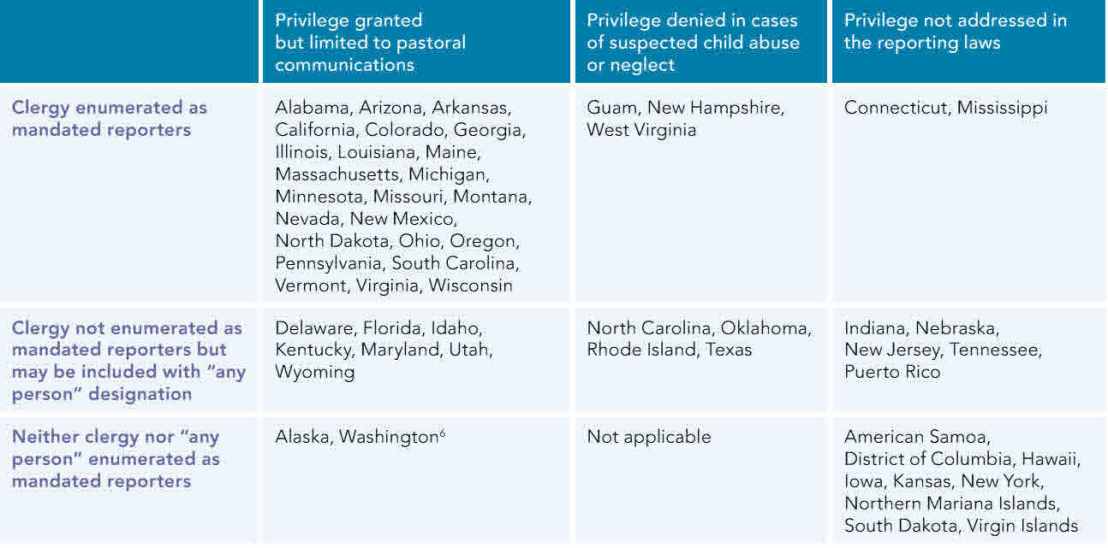
A version of the table below was copied in these reports a couple of years ago. Below is the 2019 version. While confessional privilege may be listed as “denied” in two states and a territory, it remains to be seen whether there will be or ever has been a prosecution for violation by a bone fide clergyman from a denomination with established confessional confidentiality. States that do not have confessional privilege exceptions in the mandatory reporting statute generally omit clergy from the list of mandatory reports so whether there is any duty on clergy is unclear.

Table Confess
Source: Child Welfare Information Gateway (2019), US Dept. of Health and Human Services.

In Nunez v Watchtower Bible and Tract Society of New York, Inc., 2020 MT 3 (Mont. 2020), a trial court judgment upon a jury verdict for $4 million and punitive damages of $35 million were overturned. The Montana statute contained a confessional privilege, as set forth, too, in the table above. The Supreme Court of Montana extensively analyzed the record before it as to the confessional privilege recognized by the denomination. The denomination made it a violation of canon law to breach the confessional confidentiality. However, the denomination recognized a church officer with authority to take confessions, unlike some denominations, could violate canon law and report the confession but that punishment would be unlikely. Nevertheless, that the denomination left some discretion in the confidentiality decision did not make it the ineligible for the confessional privilege set forth in Montana’s statute. The court held it was prohibited from considering whether religious confessional conduct conformed to the standards of a particular religious group. Also, the court held that by the Establishment Clause the court was prohibited from comparing confidentiality practices between denominations to favor one over the other.

The tension between confessional confidentiality and mandatory reporting statutes remains. Clergy are simply at risk. There is no easy way out. In some denominations, confession is not meaningful without proof of repentance. However, the breadth of the proof of repentance, or the vow to be undertaken to cure the sin, are beyond the scope of this report.

PUBLIC SEX OFFENDER LISTS – PART 2

Because the Texas Civil Appeals Court issued two separate opinions from the same case, and because the case may generate some interest, two reports on the same case seemed most efficient.

Texas by statute limits lawsuits that may involve “exercise of the right of free speech, right to petition, or right of association.” Tex. Civ. Prac. & Rem. Code Ann. §27.003(a). In order to present a claim of defamation allowable under the statute, a plaintiff must present evidence that supports the elements of their claim sufficient to present a viable claim.

In Diocese of Lubbock v Guerrero, Slip Op. (Tex. Civ. App. 7th, 2019), in order to present a defamation claim sufficient to overcome the protection of a free speech claim, the Claimant Guerrero had to prove there was an exercise of free speech. Naming him on the publicly disseminated list of sex offenders “credibly accused” by the diocese qualified as free speech. The list was a “communication.” The list addressed a matter of “public concern.” The elements and proof of the defamation claim was summarized in our prior post on this case and the appellate court deemed it sufficient to state a cause of action. The diocese admitted it had no evidence the Claimant sexually assaulted someone under the age of 18 even though the Claimant was listed among those who allegedly had done so. The allegation against Claimant was that he engaged in sexual misconduct with an adult. The reason the adult was classified as a victim, such as inability to consent or other possible claims, was not recited in the opinion. While Claimant was allowed to pursue his defamation claim at the trial court level, the appellate court also dismissed the claim of intentional infliction of emotional distress. Claimant had no evidence the diocese intended to emotionally harm him. The diocese defined “minor” as anyone not capable of giving consent. Sanctions and attorney fees might be awarded against Claimant on the emotional distress claim on remand to the trial court.

While the cost of the conspiracy of silence, and possibly tolerance, was high, that does not automatically mean that transparency would not also be costly. Most likely, churches will chose to settle with credible victims and litigate with alleged perpetrators. A few such trials might be the next step, and cost, of transparency.

PUBLIC LISTS OF SEXUAL OFFENDERS – Pt. 1

The Roman Catholic Church set off on a bold path when it decided to publicly list by name the persons it determined where “credibly” accused of sexual misconduct while holding church office. Such public accusations needed to be right and true in order to avoid defamation claims by alleged perpetrators.  Those lawsuits have started.

In the case of In Re Diocese of Lubbock, Slip Op. (Tex. Civ. App. 7th, 2019), the trial court refused to dismiss the defamation claim by a former deacon listed publicly by the diocese as a sex offender. However, while lumped in with others accused of sexual misconduct with children, the claim against the former deacon was sexual misconduct with an adult. The appellate court, considering an extra-ordinary writ challenging the action of the trial court, affirmed the trial court. The appellate court at length recited that internal accusation by a church of a member in accord with the church disciplinary religious doctrine could not be considered by a court because it was shielded by the Ecclesiastical Abstention Doctrine. But, once the accusation was made public by the church, and not merely leaked inadvertently or without authorization, the Ecclesiastical Abstention Doctrine no longer applied. The case was remanded for further proceedings.

It would be interesting to know if denominations or churches that have decided to use publicly disclosed lists of “credibly accused” sexual offenders did so calculating the potential for additional claims. If so, the risk analysis may have led to them to believe the risk was less than the cost of lack of transparency. Truth is a defense in a defamation case but “credibly accused” may or may not be enough. Most denominations and churches issuing such lists have done so only after qualified counsel consumed many hours of billable time to assess the claims. The reported case may put that to the test.